Stall Tactics: Why Britain’s Weekend Food Markets Are the Cheapest R&D Lab You Can Rent
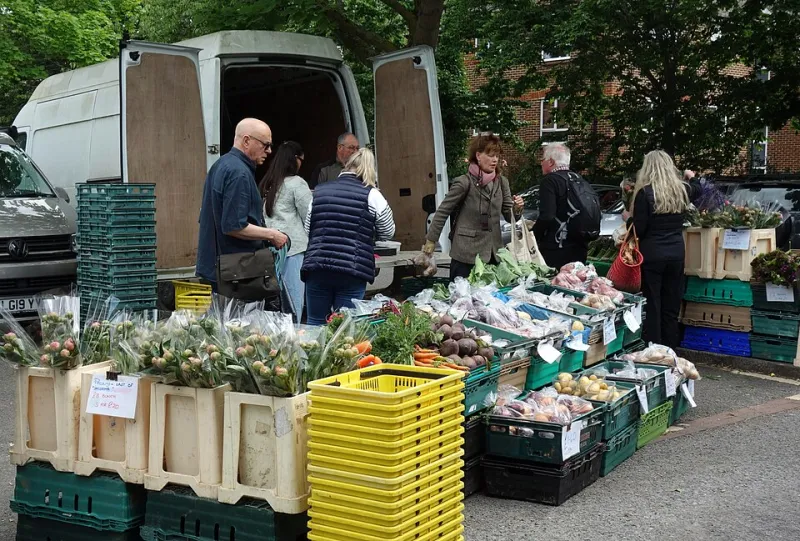
Photo: Daderot, CC0, via Wikimedia Commons
It is 7am on a Sunday and a founder is wrestling a gazebo into a market square. There is a folding table, a card reader, a stack of jars and a hand-written sign that says ‘try before you buy’. By 10am, the first customers will start asking the questions that no amount of desk research can answer: Is it vegan? How long does it keep? Can I freeze it? Why is it £7?
For Britain’s independent food and drink producers, that awkward, repeated, slightly chaotic experience is one of the most useful pieces of business infrastructure available. A weekend stall is a focus group, a pricing experiment and a brand rehearsal rolled into one. It is also a lot cheaper than a bad retail launch.
Why a stall beats a survey
People are polite on surveys. They are less polite with their feet. At a market, a customer either stops, asks a question and buys, or walks past. That is not statistically perfect data, but it is directional feedback delivered in hours rather than weeks.
A founder can watch hesitation in real time. They can see whether the label is legible from two metres away. They can hear whether the product gets described as a ‘treat’, a ‘store cupboard staple’ or a ‘gift’. They can test a £4 jar against a £7 jar and learn more about price perception than a spreadsheet of competitor prices will ever tell them.
This is especially useful for early-stage consumer brands because the biggest unknowns are rarely about production. They are about language, ritual and repeat purchase. How do customers actually use the product? What do they compare it to? What would make them buy again next week?
The three things you learn before lunch
First, you learn the customer’s words. Founders often arrive with a category description they love. Customers arrive with a different one. If you call your product a ‘fermented chilli condiment’ and everyone asks whether it is ‘like Sriracha’, that is useful. It does not mean you change the recipe. It means you may need to change the shelf-talker, the website or the first line of the label.
Second, you learn about format. A jar that looks generous on a stall may look expensive on a shelf. A trial-size pack may unlock first-time buyers. A multi-pack may suit the gift shopper but confuse the weekly shopper. These are not abstract packaging questions. They are margin questions, courier questions and retail listing questions in disguise.
Third, you learn the occasion. Is this a Saturday treat? A Friday-night cooking shortcut? A Christmas gift? A lunchbox filler? The answer affects everything from pack size to where the product should be sold. A farmers’ market is good at surfacing those occasions because customers are standing in front of you, often with a bag of other shopping, explaining how they expect to use it.
From stall to shelf: translating feedback
The trap is overreacting to one comment. One customer saying ‘too spicy’ is not a product strategy. Ten customers saying ‘I love it but I wouldn’t finish a jar that size’ is a pattern worth testing.
Sensible founder-operators keep a simple tally. Units sold. Average basket. Repeat customers. Most common questions. Most common objection. Then they make a small number of changes and test again the following weekend. The point is not to perfect the product at the stall. It is to remove the obvious friction before spending money on retail-ready packaging.
Retail-ready means something specific: stable shelf life, clear allergens, barcodes, case sizes, sensible margins and packaging that survives a courier. Stall feedback does not replace that work. It informs it. A market can tell you that customers want a smaller jar; it cannot tell you whether a retailer will accept the case size or whether the margin works after distributor fees.
The economics of proximity
A pitch fee, a tank of fuel and a day of lost production time are not free. But compare them with a failed packaging run or a listing that dies on shelf because the price point was wrong. For many early-stage brands, the market is the cheapest R&D they can access.
Proximity also builds founder intuition. There is a difference between reading a trend report about ‘permissible indulgence’ and watching 40 people decide whether your brownie is a snack or a dessert. That intuition is hard to outsource.
Retail buyers know this too. A founder who has sold direct, handled complaints, managed stock and watched customers hesitate is usually more commercially grounded than one who has only pitched a deck. Market trading is messy, but it is evidence.
What markets don’t tell you
Weekend food markets have a selection bias. The people who shop there are not a perfect sample of the national grocery market. They may be more curious, more local and more willing to browse. A product that sells well at a food hall may stall in a convenience store.
Markets are also poor at testing repeat purchase at scale. You can see whether someone comes back the next week, but you cannot see whether they would buy the product again in a supermarket three months later. And they will not tell you whether a distributor will take 25 per cent margin and still leave you with a business.
So treat the stall as one input, not the answer. Use it to sharpen the product, the language and the pitch. Then test in a handful of independent retailers, farm shops or delis. Only after that should a founder start chasing bigger listings.
A practical cadence
A useful approach is to commit to six to eight markets across different demographics, rather than one friendly local stall. Track the same handful of metrics each time. Ask open questions. Keep a notebook rather than relying on memory. After each market, write down three changes maximum and park everything else.
In 2026, the UK food and drink market is crowded and the cost of getting a listing wrong is high. That makes low-cost, high-feedback testing more valuable, not less. The Sunday market will not replace proper research. But for many founders, it is the closest thing to a real customer conversation they will get before a retailer decides their fate.
At Akkail, we like this kind of niche business story because it is quietly practical. The stall looks old-fashioned. The learning is anything but. A folding table and a queue can tell a founder more about their product than a polished deck ever will.